Even for experienced freelancers, quoting on new projects can be a challenge. One of the inherent tensions is timing: quotes are often requested before committing to a project. This is completely reasonable, but it’s the same moment where there’s the least information available about the project.
One common solution is to perform a discovery phase before committing to a scope and fee. Even then, there’s a reasonable chance the scope will change during the project, leading to dreaded “out of scope” conversations or the risk of being locked to a set of deliverables that won’t result in a good outcome.
Instead of trying to land at a flat number with limited information, I offer ballpark ranges instead.
Project data
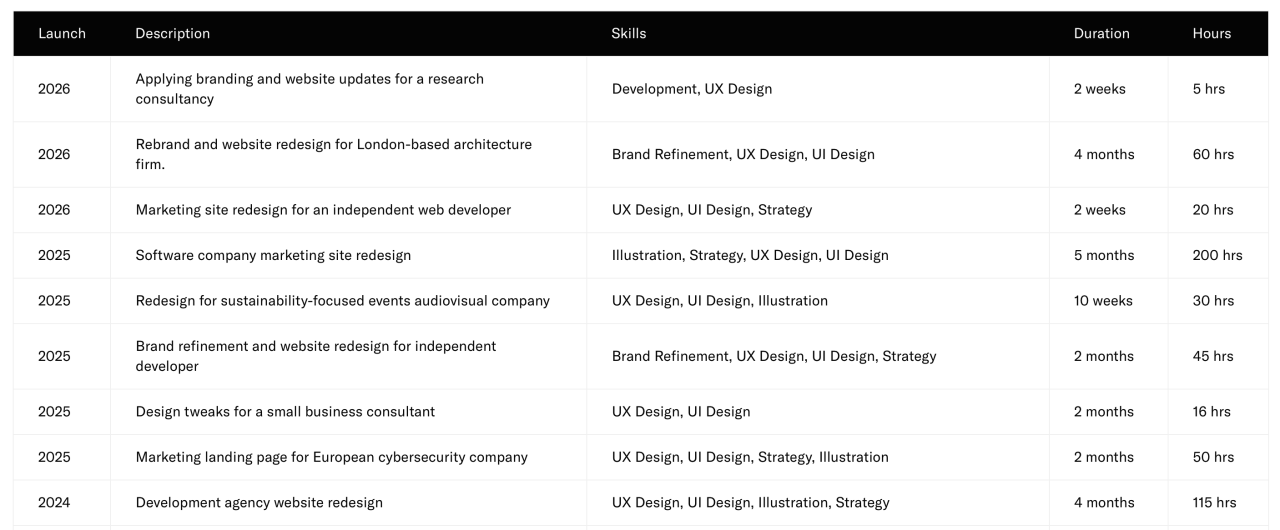
I’ve been billing my services on a time and materials basis since 2022 which means I have a diligent log of the time spent on every project I’ve billed since then. I publish this data as part of my push for transparency, and to give potential clients an idea of how long things can take.
These project logs also let me interrogate the data retrospectively. For instance, I know that in 2025, my average engagement was 68 hours, with a highest of 200 and lowest of 16.
That might not be totally helpful in the abstract, but when a client asks me for a ballpark there are a few approaches we can take. I might say:
“These two similar projects took A and B hours, so I think we might be looking at something between C and D.”
“My average project last year was X hours, and I think this is higher/lower than that”
“The budget you’ve set aside gives us X hours, here’s the best use of it”
I’ve found that these starting points have been a reliable and quick way to ballpark quotes, and a good way to kick off budget conversations.
Transparency
It’s not uncommon for clients to be hesitant about sharing a budget. There’s a fear that the quote will will be inflated to magically match their number.
I’d hope that my transparency around previous project durations goes some way to allay those anxieties: a quote significantly outside the typical range for a similar project would be pretty obvious and need justification.
Most of the projects I work on are marketing sites for small businesses and organisations. In practice, it’s rare that budgets are large enough that there’s a surplus on design budget, so we’re usually prioritising around the available time.
Even in these circumstances, being open about budget serves a couple of purposes. It can give us:
An indication of appetite: how much does the organisation currently value their site or its role in the business?
A useful creative constraint: if we have a strict budget, what’s the best way to use that time?
Both of these can be useful lenses to kick off budget conversations.
Whatever the situation, I’m conscious that we allocate a decent amount of time for discovery and exploration. If we make that element of the process artificially lean, we risk missing details that can significantly impact the outcome. That can be hard to rectify in later stages and it’s generally a situation to avoid.
We want the process to be as short as possible, but no shorter.
Example budget ranges
I know that last year my biggest engagement was 200 hours and the smallest was 16. Breaking that down a bit further, what do different effort ranges typically look like?
10 hours or under
Light consultancy, some design work
Tweaks to existing sites
10–40 hours
Small/micro site designs
Light feedback loops: in this range I might make more executive decisions and have more creative control to keep things on budget
40–90 hours
This is sweet spot territory for small marketing sites
My general recommendation is 50–75 hours as a decent chunk of time to allow
The lower end of this scale allows for a very lean design process of a marketing site
90+ hours
Anything above this usually indicates that a project has one or more areas of complexity beyond a small-ish marketing site. That might be related to the size and structure of a site/project, specific functionality that needs designing or complex UX needs.
It could be something as simple as needing a range of custom illustrations, or it might be a regular engagement over a sustained period.
Wrapping up
The TL;DR of this post could be “use previous projects to ballpark new quotes”. To me, there are two critical elements:
The practice of tracking and publishing previous project durations grounds future estimates in something tangible and transparent
Quoting in ranges rather than a flat figure hints at the inherent flexibility of the design process
If the budget is fixed, we’ll be working towards optimising the time we have. If we’re viewing budget through the lens of previous projects, we’ll be talking in broad strokes rather than deciding which rivets are in or out of scope.
These days, if I’m asked for a ballpark on a small/medium marketing site during early conversations, I’m usually able to get to a reasonably accurate ballpark using one of these methods. That’s quite a change from times past where I’d spend a non-trivial amount of time interrogating and analysing a project brief before getting to a number.
Explore
Using video for design feedback
22 May 2020